Germany’s Path to Synergy Between AI Technology and Talent
Artificial intelligence (AI) is a key area for Germany to enhance its national technological innovation capabilities and compete in the global tech industry. To seize opportunities in AI development and address challenges such as the disconnect between technology research, talent supply, and industrial demand, Germany has successively launched the “Federal Government AI Strategy” and its updated versions in 2018, 2020, and 2023, along with the “High-Tech Agenda” starting in 2025. This initiative aims to create a development system characterized by “strategic leadership, core universities, platform support, and collaborative interaction,” promoting the integrated development of AI education, technology, and talent, thereby forming a practice path with German characteristics that provides valuable insights for other countries in systematically laying out their AI education and talent strategies.
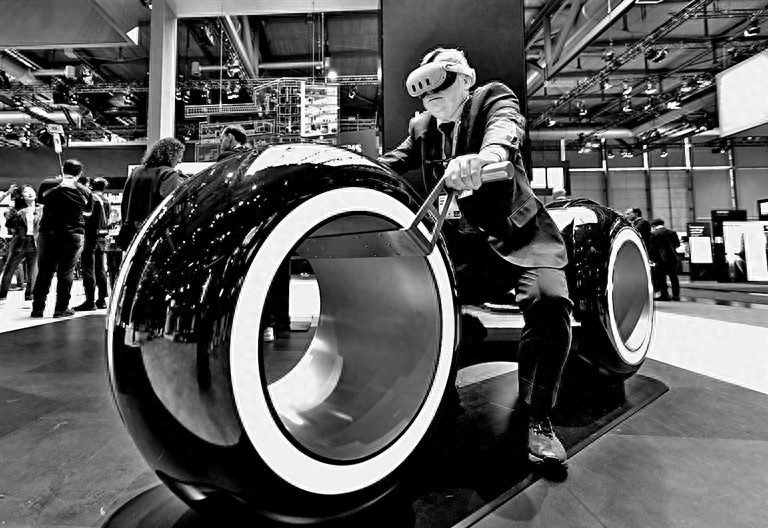
On April 20, a man experiences VR equipment at the Siemens booth during the Hannover Messe in Germany.
Strategic Leadership: Anchoring the Direction of Integrated Development of Education, Technology, and Talent
Talent is the core link connecting education and technology, and is the primary resource for AI development. Germany has consistently utilized national strategy as a lever, continuously iterating on top-level design to clarify the collaborative relationship among education, technology, and talent, gradually strengthening the strategic orientation for integrated development, and providing solid policy support and financial guarantees for various practical measures.
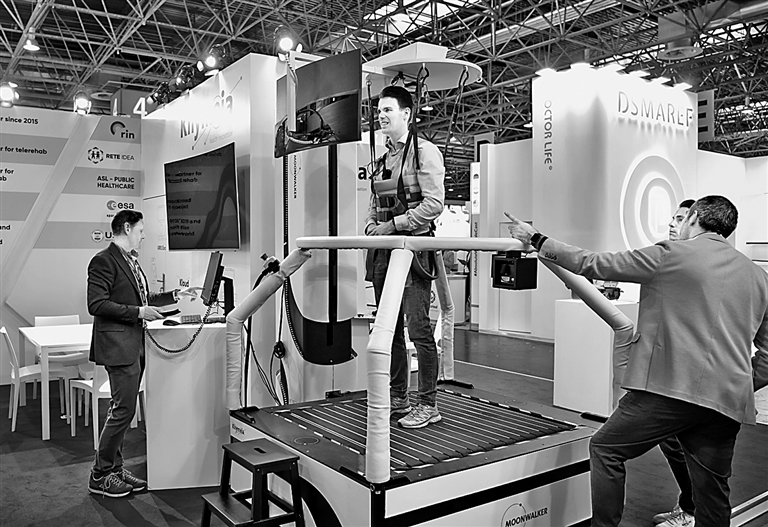
Visitors experience rehabilitation equipment at the 2025 International Medical Devices Exhibition in Düsseldorf, Germany.
The 2018 “Federal Government AI Strategy” explicitly identified education and talent as decisive factors for ensuring the development of AI research in Germany, emphasizing the need to systematically expand AI education supply and popularize AI knowledge and skills across all levels of the education system, aligning educational content with future societal development needs.
In 2020, the German federal government updated its AI strategy and increased funding to 5 billion euros. The government stressed that a broad and high-quality professional talent pool is fundamental for Germany to join the global leading ranks in AI research and application, necessitating the expansion of AI talent reserves through higher education, vocational training, and continuing education.
In 2023, in response to the rapid development of generative AI and the new challenges it brings, the federal government updated its strategy again, introducing the “AI Action Plan” which positions talent alongside research, data, and computing power as the four fundamental elements driving AI development, serving as the cornerstone for Germany to maintain its technological sovereignty and global leadership.
By 2025, the new German government, in its first top-level strategy for technological innovation, the “High-Tech Agenda,” further reinforced the strategic orientation for integrated development. This agenda identifies key technologies like AI as innovation breakthroughs and lists the cultivation and introduction of professional talent as key support for its successful implementation. To realize this strategy, the Federal Ministry of Research, Technology, and Aerospace allocated 1.5 billion euros in the 2025 budget to support research innovation and talent cultivation in key technologies like AI, enhancing Germany’s competitiveness in critical technology areas through collaborative investment in technology and talent.
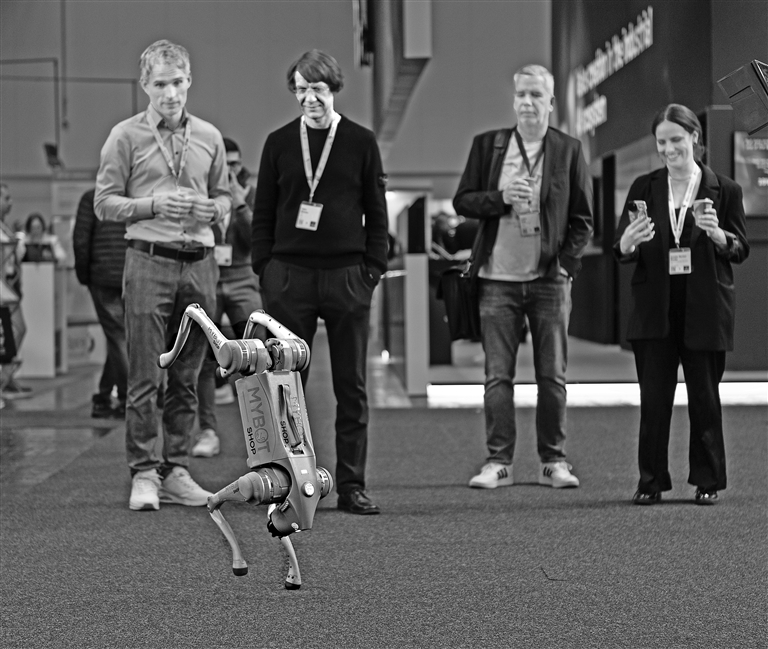
On April 20, people watch a mechanical dog performance at the Hannover Messe in Germany.
Core Universities: Building a Comprehensive Talent Cultivation and Research Support System
The German federal government positions higher education as the core hub for the integrated development of education, technology, and talent, implementing a series of measures to promote the comprehensive integration of AI into university research and teaching, and to strengthen universities’ research and educational capabilities.
The “AI Funding Initiative in Higher Education” aims to fully integrate AI into the higher education system. In November 2020, the German federal government and state governments jointly approved this initiative, committing approximately 133 million euros from 2021 to 2025, in a 9:1 ratio, to fund universities in fully integrating AI into their teaching systems. Funding targets two areas: first, to support universities in developing AI curriculum systems or teaching modules to enhance academic talent cultivation; second, to fund the application of AI technology in university teaching and management. Independent universities can receive up to 2 million euros, while joint applications can receive up to 5 million euros. A total of 54 projects were funded, benefiting 81 universities.
A large-scale increase in AI professor positions solidifies the foundation of AI in universities. The 2018 AI strategy called for the addition of at least 100 AI-related professor positions nationwide by 2025 to address the shortage of faculty in AI at German universities and enhance their academic research and teaching capabilities. This goal was achieved ahead of schedule in 2022. By 2023, the Federal Ministry of Research, Technology, and Aerospace had added over 150 professor positions through diverse support paths such as the Humboldt Foundation, the German Research Foundation, AI competence centers, and tenure-track programs. These positions are widely distributed across major comprehensive and technical universities in Germany, reinforcing the foundation of AI academic research and education.
AI-related degree programs have been established, forming a complete training chain from undergraduate to doctoral levels. German universities offer a comprehensive range of AI courses covering core areas such as machine learning, neural networks, natural language processing, computer vision, and robotics, with the number of courses ranking among the highest in Europe. Furthermore, German universities place great emphasis on the interdisciplinary nature of AI, integrating AI knowledge into traditional disciplines such as philosophy, economics, medicine, media, and law. As of 2022, the number of interdisciplinary AI courses outside of computer science has increased fivefold, totaling 109 courses, most of which are offered as “open courses” accessible to students from all majors. To strengthen the cultivation of AI master’s and doctoral talents, in 2022, the Federal Ministry of Research, Technology, and Aerospace, in collaboration with the German Academic Exchange Service, launched a graduate program named after German computing pioneer Konrad Zuse—the “Konrad Zuse AI Excellence Academy.” This program features interdisciplinary, cross-field, and international teaching, gathering top experts from academia and industry to form a mentoring team that provides students with academic guidance, research topics, and practical opportunities, while supporting their participation in international exchanges. The three academies are led by Darmstadt University of Technology, Dresden University of Technology, and Technical University of Munich, in collaboration with various research institutions and enterprises, focusing on key areas such as machine learning, trustworthy AI, and health AI. Each academy receives up to 3 million euros annually from the Federal Ministry of Research, Technology, and Aerospace for operational funding.
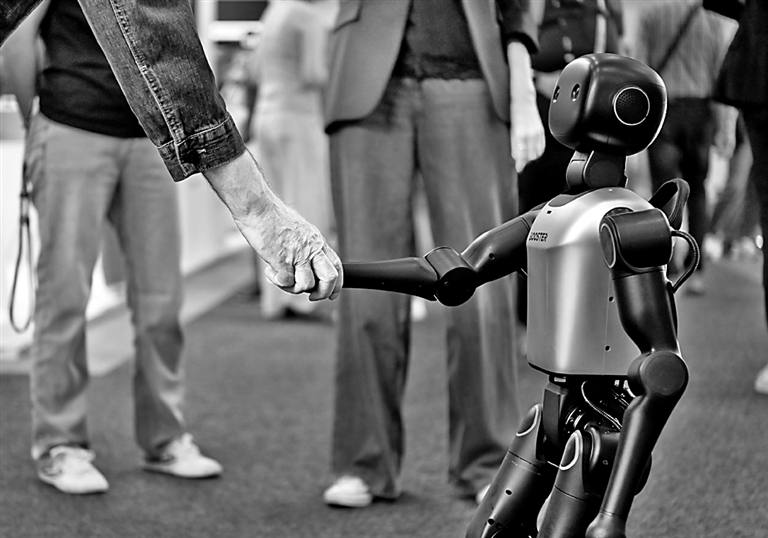
An audience member shakes hands with a humanoid robot at the 2025 International Consumer Electronics Show in Berlin, Germany.
Building Platform Frameworks: Enhancing Collaborative Efficiency in Research Innovation and Talent Cultivation
Germany emphasizes the establishment of diverse platform frameworks that integrate resources from universities, research institutions, and industry, promoting deep collaboration between research innovation and talent cultivation to overcome bottlenecks in AI development related to computing power, technology, and talent, thereby constructing a collaborative development system characterized by “competence centers leading, professional alliances supporting, and infrastructure guaranteeing,” enhancing the overall effectiveness of integrated development in education, technology, and talent.
The establishment of AI competence centers aims to create a national team for AI research and a high ground for talent cultivation. Since 2018, the German federal government has established five AI competence centers at top universities such as the Technical University of Berlin, Dortmund University of Technology, Dresden University of Technology, Tübingen University, and Ludwig Maximilian University of Munich, covering major research directions and methodologies in AI such as machine learning, big data, and computer vision. These centers are dedicated to promoting breakthroughs in frontier science, cultivating young scientific talent, and building core platforms for AI technology research, application, and talent cultivation at the national level. The competence centers are based at universities, jointly established with research institutions, and closely collaborate with enterprises, forming a national-level AI collaboration network characterized by resource sharing and interconnectedness. In 2022, the Federal Ministry of Research, Technology, and Aerospace transitioned the funding model for competence centers from short-term project-based to permanent institutional support, aiming to provide long-term guarantees for their AI research and talent cultivation through stable funding. The Federal Ministry of Research, Technology, and Aerospace and the state governments jointly provide long-term funding in a 5:5 ratio, with an annual total of up to 100 million euros, with each competence center receiving between 15 million and 25 million euros annually.
The establishment of a networked German Robotics Research Institute aims to create a top national robotics research alliance and talent training factory. Robotics, as a key area of AI, presents significant opportunities for German innovation. In 2024, the Federal Ministry of Research, Technology, and Aerospace, in collaboration with 14 top universities and research institutions, as well as over 20 partner organizations, established the German Robotics Research Institute (RIG), providing 20 million euros in funding over four years to promote cutting-edge robotics technology research and education, helping Germany become a global leader in embodied AI. RIG has developed a research-oriented talent cultivation plan that spans from undergraduate to doctoral levels, aimed at meeting the growing demand for professionals in the robotics field. Specific measures include offering introductory courses in robotics to guide undergraduates into the field of robotics research; providing English-taught master’s programs in robotics, and establishing fast-track doctoral programs to accelerate high-level talent cultivation. Additionally, through industry internships and specialized training, students’ practical industry capabilities are strengthened.
The establishment of a national high-performance computing network for universities aims to overcome bottlenecks in research computing power. The National High-Performance Computing Network (NHR) is a national-level AI infrastructure project jointly funded by the German federal government and state governments, aimed at integrating and enhancing high-performance computing resources at universities to provide internationally competitive computing support for university researchers. NHR is composed of computing centers from nine universities, including RWTH Aachen University, Darmstadt University of Technology, Dresden University of Technology, Friedrich-Alexander University of Erlangen-Nuremberg, Frankfurt University, University of Göttingen, Berlin University Alliance, Karlsruhe Institute of Technology, and Paderborn University, covering major research clusters in Germany. In addition to providing critical computing support for cutting-edge fields such as AI and big data research, NHR also places a high priority on talent cultivation, offering a series of training courses from basic to advanced levels to enhance researchers’ methodological capabilities, and establishing the NHR Graduate School, which offers up to nine doctoral scholarships annually. In terms of funding, the Federal Ministry of Research, Technology, and Aerospace and state governments jointly invest 62.5 million euros annually in NHR, with funding set for the period from 2021 to 2030. In 2024, the Federal Ministry of Research, Technology, and Aerospace further proposed in the “German AI Computing Infrastructure Action Plan” to equip NHR with processors suitable for AI applications to continuously enhance its technical support capabilities.
AI technology is the core engine driving a new round of technological revolution and industrial transformation. The deep integration of education, technology, and talent is key to promoting high-quality development in AI. Germany has formed a collaborative development model that effectively links universities, research institutions, and industry, driven by national top-level strategies, centered on higher education, and supported by platform frameworks, providing a reference experience for countries worldwide to address challenges in AI development and improve relevant field layouts, while also injecting lasting momentum into the sustainable development of AI technology.
Comments
Discussion is powered by Giscus (GitHub Discussions). Add
repo,repoID,category, andcategoryIDunder[params.comments.giscus]inhugo.tomlusing the values from the Giscus setup tool.