When global developers are excited about Claude Code’s engineering capabilities, viewing it as the ultimate answer for AI programming, a creator sharing event in Hangzhou may have provided a closer answer to the future. At the event, Ant Group’s “Lingguang App” officially launched a significant upgrade to its flash applications, and the flash application community “Lingguang Circle” went live. This first consumer-grade Coding Agent in the industry realizes a complete loop of “creation - usage - sharing - re-creation”.
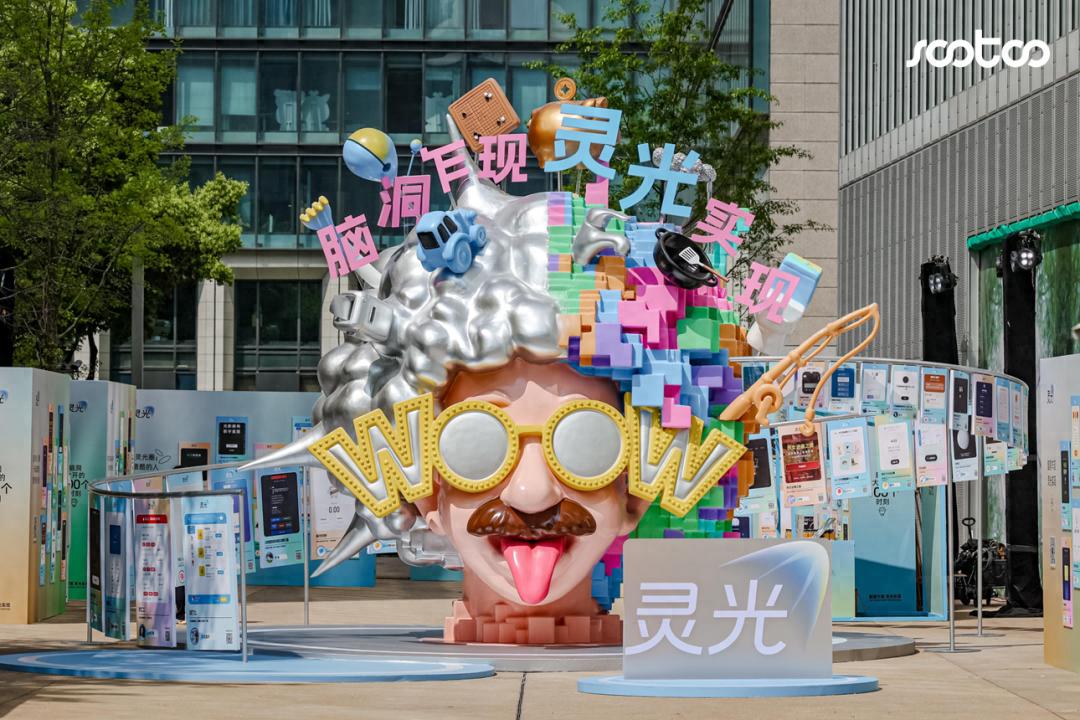
Another impressive statistic is that within less than six months of its launch, Lingguang users have created over 30 million flash applications, averaging two applications created every second, vividly illustrating the democratization of AI-driven software productivity.
Claude Code: A Revolution in Efficiency, Not Paradigm
We must acknowledge the value of Claude Code. Anthropic has indeed pushed AI programming capabilities to new heights. Cai Wei, the head of Lingguang, who has a background in Silicon Valley and worked at Google for many years, shared that a colleague told him last year, “There is actually no such thing as Vibe Coding anymore; writing code has become obsolete.”
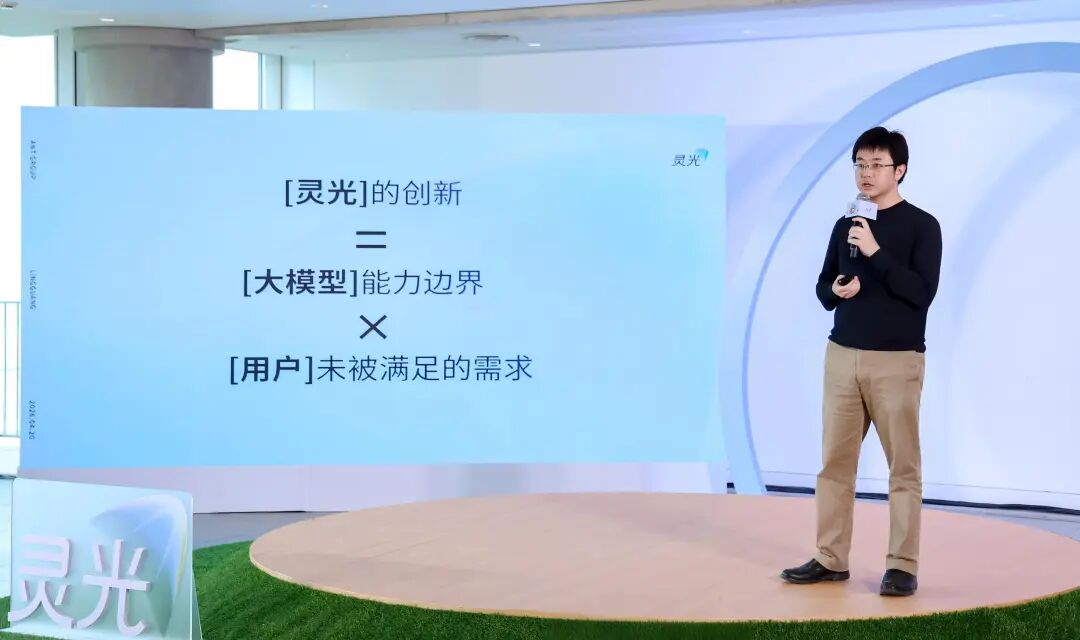
Cai Wei, Head of Lingguang App
The reality has come faster than expected. Tools like Claude Code, representing Vibe Coding, can understand the complete project structure, automatically complete the entire code writing, debugging, and refactoring process, seamlessly integrate with development tools like Git, and support the development needs of large projects with an extended context window. It has exponentially increased the efficiency of experienced developers while lowering the entry barrier for beginners.
However, the problem is that it has always been a tool serving the programmer community. To effectively use Claude Code, one still needs to understand code logic, project architecture, environment configuration, and deployment debugging. It addresses “writing code efficiency” but does not resolve the “barrier to writing code.”
Claude Code remains too distant from the average person.
In contrast, Lingguang’s core logic has transcended the framework of “code” since its inception. Its proposed Wish Coding essentially encapsulates the act of “writing code” into a technical black box. Users do not need to understand any development knowledge; they simply need to express their needs in everyday language, and the AI will handle the complete code generation, full-link deployment, and full-function delivery in the cloud. Within 30 seconds, users can obtain a complete application that is ready to use, can be modified at any time, and can be shared with one click.
The significance of this is that it finally addresses long-tail needs with an AI coding tool.
For decades, the software industry has focused on allowing a few people to develop general applications to serve the common needs of the majority. The vast array of personalized, niche, and scenario-based long-tail demands has never been genuinely considered because ordinary people cannot do it, and professional developers overlook it. It’s somewhat akin to the development of rare disease medications, where the effort is extensive but the commercial value is low.
Cai Wei provided an example: a user from Henan named Mao Qiang created a flash application called “Grandparents’ Microphone” using Lingguang. The product is straightforward, featuring large buttons labeled “Go to the bathroom, Turn off the lights, It’s a bit cold, Change the channel,” greatly simplifying communication with family members who have speech difficulties. This is not a new case, but it is still representative.
Similarly, Ms. Tu from Wuhan, whose mother was diagnosed with late-stage stomach cancer, needed to strictly record water intake while resting at home, a tedious and error-prone task when done manually. With Lingguang’s flash application, she created a statistical tool that automatically calculates data and retains complete records, facilitating follow-up consultations. She is also willing to share it freely to help other families in similar situations.
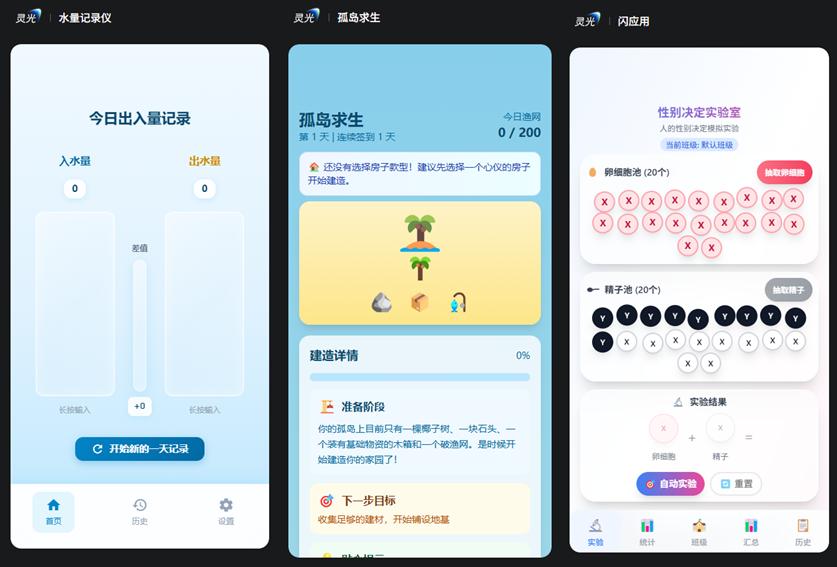
Some flash applications developed by creators
A 95-born biology teacher from Foshan, Teacher Zhou, like many teachers, was troubled by the cumbersome traditional experimental teaching tools. However, she used Lingguang’s flash application to create a simulation experiment tool, reducing classroom experiment time to within ten minutes and significantly improving teaching efficiency.
There are many such examples. Those who shared at the event included Bilibili creators, video studio owners, stay-at-home parents, designers, and college students, all of whom share a common trait: they are novices in coding, yet they all identify as “flash application creators.” The applications they handcrafted are diverse and unique, fulfilling their own needs while helping many others with similar requirements.
Thus, when middle and high school students, non-IT professionals, and ordinary enthusiasts can create dedicated applications for their real needs, the development barrier is completely erased, and we truly enter the “one-person application era.”
As a participant from Tongji University shared, “As long as you have a bit of creativity, you can amaze the world.”
Lingguang Circle: A Public Version of GitHub
For a tool to thrive, collaboration and presentation are as important as product strength, as evidenced by GitHub’s status. The Lingguang team clearly understands this and has not stopped at creating an AI coding tool but is also building a complete consumer-grade AI application creation ecosystem.
The newly launched “Lingguang Circle” is the industry’s first zero-code application sharing community, allowing users to publish their flash applications with one click for others to use immediately. It also opens up the ability for secondary creation—developers can continue to modify, iterate, and optimize based on others’ ideas, forming a complete loop of “creation - usage - sharing - re-creation.”
This is a value that single-player tools like Claude Code cannot achieve: it transforms ordinary people’s creativity into a digital asset that is shareable, iterable, and symbiotic.
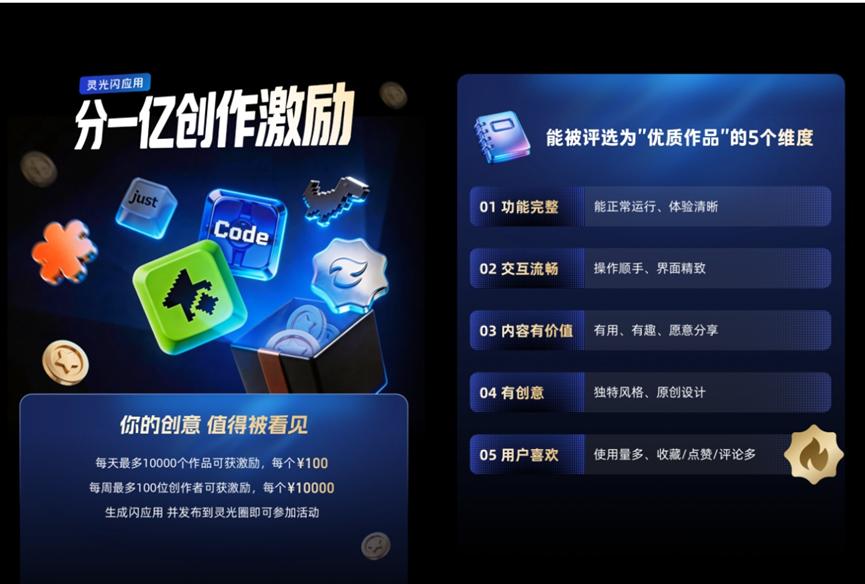
To further stimulate individual creativity, the Lingguang App announced the “Lingguang Flash Application Creator Incentive Program,” which will invest 100 million yuan in a special fund to support high-quality flash applications and outstanding creators.
Compared to the tens of billions spent in AI New Year red envelope wars, 100 million is not much, but it is indeed a tangible incentive. The future community’s activity and sustainability will also test the strategic determination of the Lingguang team.
What is the Endgame of AI Coding?
In the years of evolution in AI coding, there has been ongoing debate about what the endgame is.
Sutu.com believes that the explosive performance of GPT-Image2 today has already proven: allowing ordinary people to express their needs to AI in natural language and produce works that exceed professional standards is nearly the endgame.
This aligns with the Wish Coding proposed by Lingguang—allowing code to be completely hidden in the background, so ordinary people do not need to know how it works, only what they want.
From this perspective, Claude Code is merely a transitional phase in the industry’s development, while Lingguang is touching what could be the ultimate form of AI coding.
Comments
Discussion is powered by Giscus (GitHub Discussions). Add
repo,repoID,category, andcategoryIDunder[params.comments.giscus]inhugo.tomlusing the values from the Giscus setup tool.