AI Transforming Cyber Threats
Artificial intelligence is rapidly changing the landscape of cyber threats. A new report from the Google Cloud Threat Intelligence team indicates that attackers are using AI to enhance the effectiveness of exploitations and gain initial access.

The report highlights a notable shift in attacker behavior. Instead of primarily stealing credentials or conducting phishing attacks, attackers are increasingly targeting software vulnerabilities and cloud services, making exploitation a primary method of attack.
One of the key findings is the growing role of AI in attack operations. Attackers are no longer just using AI to write phishing emails or automate repetitive tasks; they are now attempting to use AI systems capable of identifying vulnerabilities, generating attack code, and accelerating the attack chain.
Google researchers warn that the cybersecurity industry is entering a new phase of AI-enabled cybercrime. The report points out that threat organizations are increasingly integrating AI into various stages of the attack lifecycle, from reconnaissance to exploitation and malware development.
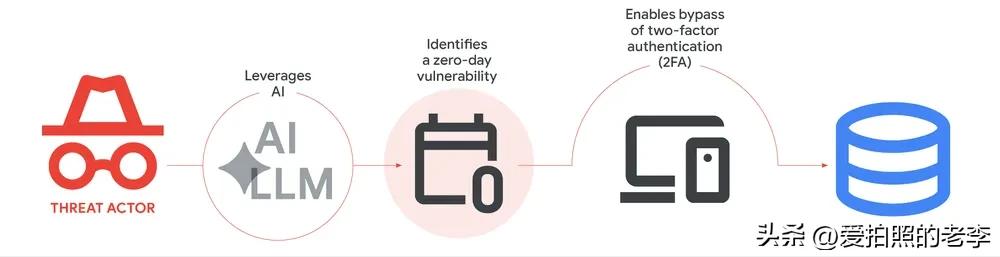
AI-Driven Exploitation of Zero-Day Vulnerabilities
The report states, “AI malware like PROMPTSPY signifies that attack orchestration is moving towards autonomy, where models interpret system states, dynamically generate commands, and manipulate victim environments. Our analysis of this malware reveals previously unreported functionalities and scenarios of AI integration. This approach allows attackers to outsource operational tasks to AI, enabling scalable and adaptive attack activities.”
Researchers caution that threat organizations are not just using AI for efficiency. Cybercriminals are now testing AI systems capable of adapting to environments, making automated decisions, accelerating actions, and supporting tasks that previously required human intervention, marking a significant shift in modern cyber operations.
The report also notes that attackers are exploiting newly disclosed vulnerabilities at an unprecedented speed. In some cases, criminals begin scanning the internet for exposed systems within hours or days after security researchers publish technical details. This acceleration leaves defenders with little time to patch systems before attackers strike.
Google has identified the first known AI-developed 0-day vulnerability linked to large-scale attack plans. Advanced threat organizations have shown a keen interest in using AI to discover vulnerabilities.
Attackers are increasingly exploiting software vulnerabilities to infiltrate cloud environments, targeting APIs, SaaS applications, developer platforms, and AI services.
AI plays a crucial role in this acceleration process. Large language models (LLMs) can help attackers analyze technical documentation, understand proof-of-concept exploitations, and generate malicious scripts faster than traditional methods. Researchers are increasingly concerned that AI may lower the technical barriers required to launch complex attacks.
The report emphasizes another critical issue: attackers are increasingly targeting a broader AI ecosystem, not just AI models themselves. Exposed API keys, insecure integrations, excessive permissions, and vulnerable third-party tools create new attack surfaces.
Recent investigations found that some Google Cloud API keys were accidentally leaked after configuration changes, preventing users from accessing the Gemini AI service. Security researchers discovered thousands of publicly leaked keys that attackers could use to access sensitive AI endpoints or incur massive cloud costs.
Google has also expanded its detection capabilities to monitor AI-related threats in cloud environments. The company now tracks suspicious activities involving AI services, including anomalous service account usage, unusual AI API calls, malicious binaries, reverse shells, and data theft attempts targeting AI workloads.
The report states, “Attackers like ‘TeamPCP’ (also known as UNC6780) have begun targeting AI environments and software dependencies as initial attack vectors. These supply chain attacks lead to various machine learning (ML) risks outlined in the Security AI Framework (SAIF), such as insecure integrated components (IIC) and malicious behaviors (RA). Our analysis of forensic data related to these attacks indicates that attackers are attempting to shift from infected AI software to broader network environments to gain initial access and conduct destructive activities, such as deploying ransomware and extortion.”
The report indicates that software-based intrusions have become one of the primary means of cloud attacks. This trend reflects that for organizations adopting multi-factor authentication (MFA) and stricter identity protection measures, credential theft is becoming increasingly difficult. Attackers are redirecting their focus to unpatched software, insecure APIs, and third-party integrations.
Another major concern is AI-assisted autonomous attacks. Researchers and security companies have documented early cases where AI systems conducted reconnaissance, vulnerability scanning, and attacks with limited human supervision.
The report also explores how threat organizations interact with generative AI systems. Google found that many attackers attempt to exploit jailbreaking prompts and prompt engineering techniques to bypass AI security measures. However, most attempts remain immature, relying on publicly available methods rather than advanced AI manipulation techniques.
The report emphasizes that AI cannot replace traditional attack techniques. Many successful security vulnerabilities still stem from common security flaws, such as misconfigurations, exposed services, weak access controls, and poor patch management. Another report from Wiz also found that basic security mistakes remain the leading cause of most cloud security vulnerabilities.
Researchers also highlight that defenders can leverage AI to enhance security operations. AI tools have already been able to assist analysts in processing telemetry data, prioritizing alerts, identifying suspicious patterns, and accelerating incident response. However, attackers can also utilize these technologies.
One of the clearest warnings in the report is that the cloud threat landscape is changing rapidly. This change is no longer limited to malware or phishing but integrates AI, cloud infrastructure, automation, and software exploitation into a faster, more scalable attack model.
The overall message from Google’s analysis is clear: businesses can no longer view AI security as a future concern. Attackers have already begun using AI to improve operations, accelerate attacks, and target the cloud ecosystem. Companies must strengthen vulnerability management, protect APIs and AI integrations, monitor third-party relationships, and shorten exposure windows as much as possible before attackers exploit vulnerabilities.
Comments
Discussion is powered by Giscus (GitHub Discussions). Add
repo,repoID,category, andcategoryIDunder[params.comments.giscus]inhugo.tomlusing the values from the Giscus setup tool.