
Artificial intelligence (AI) is emerging as a transformative force in the economy, marking the beginning of a new industrial revolution. Following the steam engine, electricity, and information technology, AI is now seen as a general-purpose technology that will significantly enhance economic growth. The question remains whether AI will drive sustained growth like its predecessors or merely provide a temporary boost. Current perspectives from academia, financial markets, and policymakers vary, but there is a consensus on the importance of AI as the fourth industrial revolution.
Over the past 15 years, global labor productivity growth has slowed dramatically, with a reduction of more than half compared to previous rates. This decline has affected both developed economies and many large emerging markets, posing challenges to medium- and long-term economic growth. The well-known Solow Paradox highlights that despite significant investments in IT, productivity gains have been minimal. Addressing this paradox in the AI era involves leveraging AI advancements to improve productivity and enhance social welfare through better income distribution.
AI is not only a catalyst for technological revolution but also a new engine for economic growth, enhancing total factor productivity and optimizing resource allocation. Its pervasive influence is reshaping the distribution of production factors across industries and regions, impacting industrial structure upgrades and employment adjustments. Existing research confirms AI’s dual effects on economic growth while raising concerns about its uneven impacts on economic structure, driving industries towards digitization and intelligence but potentially exacerbating structural imbalances.
This article aims to incorporate AI development into computable general equilibrium models to explore its overall impact on economic growth, structural opportunities across industries, and implications for income distribution, social ethics, and information security.

Total Impact of AI on Economic Growth
Current academic research categorizes AI’s impact on economic growth into conservative, neutral, and optimistic perspectives. The conservative view, represented by Daron Acemoglu (2024), expresses caution regarding AI’s ability to sustain productivity growth, predicting an annual increase of only 0.07%. This caution stems from the observation that productivity gains are primarily concentrated in easily learned tasks, while more complex tasks may hinder future productivity improvements. The neutral perspective, represented by Philippe Aghion (2024), suggests that AI could lead to annual TFP (total factor productivity) growth of 0.8%-1.3% in developed countries, accumulating to an 8%-13% increase over ten years. The optimistic view, from the McKinsey Global Institute, forecasts a 7% annual increase in global GDP over the next decade, with TFP growth exceeding 1.5% for every 10 percentage points increase in AI penetration, leading to a 23% TFP leap.
AI’s development is indeed positively influencing productivity in manufacturing and services, awaiting a revolutionary turning point. We assert that AI is revolutionary and represents the fourth industrial revolution.
As technology advances, AI is deeply integrating with various sectors of the economy and society. This integration focuses on the intelligentization of supply and demand-related industries, promoting smart production and consumption transformations based on digital technologies. By connecting isolated producers and consumers through industrial and value chains, AI is creating a new economic model where data becomes a vital resource. AI applications will replace repetitive labor, reduce labor costs, and enhance production precision and stability. Through big data mining, simulation, and intelligent algorithms, AI will shorten R&D cycles and lower trial-and-error costs, pushing technological frontiers outward.
Firstly, digital factors will be integrated into traditional production functions, becoming crucial determinants of economic growth. In agricultural societies, land and labor were the primary production factors; the industrial revolution elevated capital’s importance. The technological revolution represented by AI will position data as a new production factor. As data processing capabilities improve, and generative thinking deepens, the accumulation and optimization of data factors will profoundly influence economic growth trends.
Secondly, supply-side innovations driven by technological advancements will generate demand. The development of AI will create new scenarios and demands, transforming consumption patterns for individuals and governments, thereby promoting economic circulation and reshaping traditional lifestyles and industries. Historically, the emergence of new technologies and products has gradually altered lifestyles and created new demands, as seen with the electrical revolution leading to new needs for refrigerators and color TVs.
AI promotes economic growth through three mechanisms, addressing challenges posed by aging populations, rising labor costs, and environmental constraints. First, AI enhances automation and intelligence in production, increasingly substituting capital for labor, thus mitigating adverse impacts on economic growth. Second, AI fosters endogenous technological progress and capital deepening, improving capital returns and increasing savings and investment rates, countering declines in growth due to demographic shifts. Third, AI enhances total factor productivity through improvements in production methods, cost savings, and intelligent generation, further offsetting changes in other factor endowments that could hinder economic growth.
Traditional macroeconomic models face structural issues like diminishing returns to scale and marginal capital efficiency. The large-scale application of AI in production will embed intelligent systems into various processes, making technological progress and organizational methods more intelligent and efficient.
We reference the works of Acemoglu & Restrepo (2019, 2024), OECD (2025), Aghion (2017, 2024), Prettner (2019), and Chen Yanbin & Lin Chen (2019) to construct a dynamic general equilibrium model categorizing capital into housing, infrastructure, and real economy capital. Theoretically, all three capital categories will be influenced by AI’s development. However, for simplicity, our baseline model focuses solely on AI’s impact on real economy capital, while the roles of housing and infrastructure capital are simplified.
Our dynamic general equilibrium model comprises the enterprise sector, household sector, and government sector. Following Aghion’s approach (2017), we define the production function incorporating AI development as:
At denotes labor-enhanced technological progress, Kt is real economy capital, Lt is labor input, and ε is the elasticity of intermediate goods output, with αt representing the proportion of production tasks impacted by AI. We model AI’s influence using a “logistic function,” reflecting its slow initial adoption, rapid growth during development, and eventual stabilization, consistent with logistic function characteristics.
For the household, enterprise, and government sectors, we adopt classic utility maximization for households, profit maximization for enterprises, and a growth-service balance for the government. When the dynamic general equilibrium model reaches equilibrium, the labor market clears, with total labor supply equaling total labor demand, maximizing enterprise profits and government utility. By solving the first-order conditions for optimization in the enterprise and household sectors, along with capital change equations, we derive the equilibrium system of the general equilibrium model.
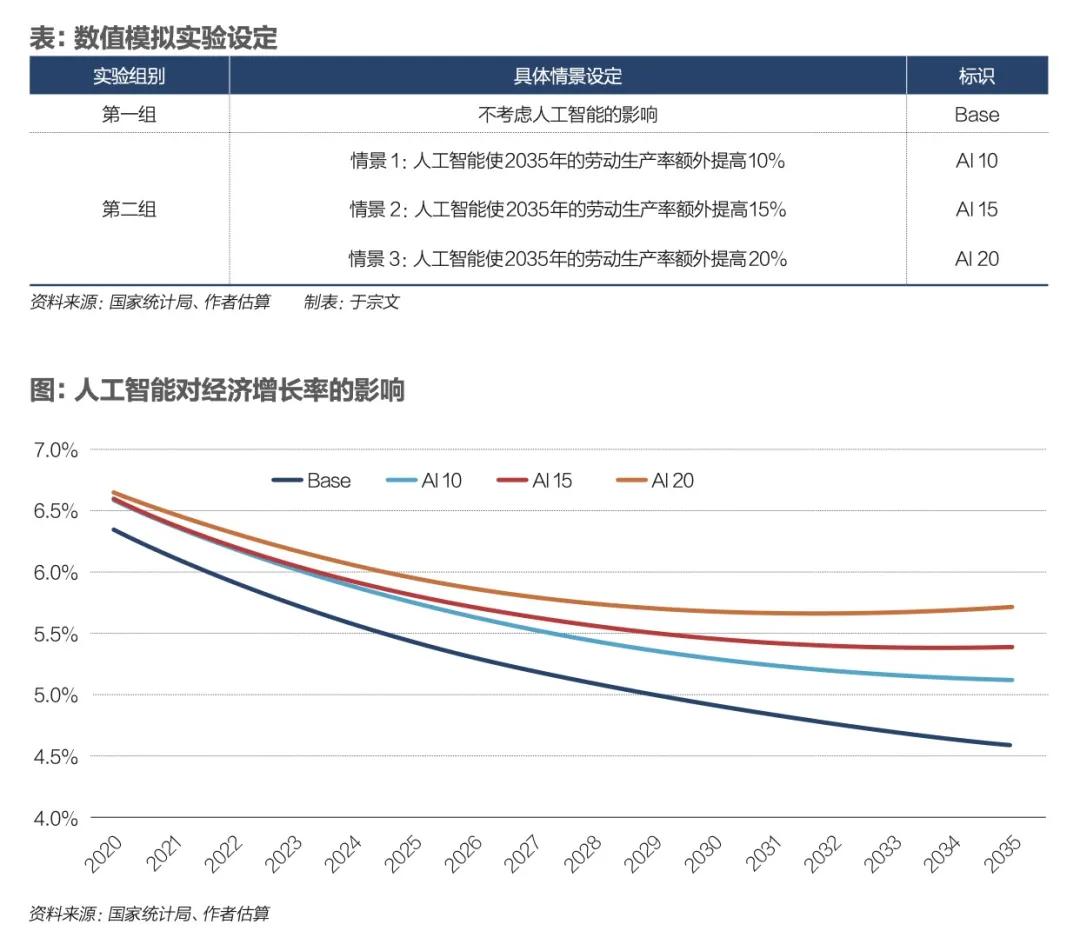
We find that while our baseline model may overestimate potential growth rates due to not accounting for aging effects, it still reveals that without AI’s influence, potential growth rates will decline rapidly over the next decade. Even under conservative assumptions, AI significantly enhances technological progress and economies of scale, stabilizing potential growth rates over time.
Our research confirms that AI does promote overall economic growth. Specifically, it optimizes capital structure, increasing the share of real economy capital while reducing housing and infrastructure capital shares, achieving both improved consumer spending and economic growth. In the past, local government debt-driven infrastructure growth and the real estate sector were crucial for economic expansion. Our estimates suggest that these two growth drivers will gradually diminish over the next decade (Liu Chenjie, 2022), signaling the need for a new high-quality growth model as the old economic growth patterns falter. AI can enhance the attractiveness of the real economy by increasing production intelligence and technological advancement, redirecting funds from real estate to the real economy, thereby alleviating the crowding-out effect of housing capital on consumption and enhancing the real economy’s growth impact. More importantly, AI can strengthen endogenous growth dynamics, reducing local governments’ reliance on infrastructure investment to stabilize growth, further alleviating the crowding-out effect of infrastructure capital on consumption and enhancing the real economy’s growth impact. Given the pressures from rising labor costs and environmental resource constraints on medium- to long-term economic growth, we must recognize AI’s role in promoting economic growth and vigorously develop AI, particularly in conjunction with the production sector.
From 2026 to 2035, potential growth rates will generally decline, driven by structural constraints like population aging and diminishing capital returns. However, under different AI penetration scenarios (10%, 15%, 20%), growth rates will significantly exceed baseline scenarios. By 2035, the baseline potential growth rate may drop to around 4.2%, while a scenario with 20% AI penetration could maintain potential growth around 5.8%, indicating that AI adoption can effectively support economic stability. AI can effectively delay declines in potential economic growth, contingent on two prerequisites: the existence of a “threshold effect” whereby when AI capital stock exceeds 2% of GDP, its marginal impact on total factor productivity jumps from 0.1 percentage points to 0.4-0.5 percentage points.
Of course, our model has limitations, such as not focusing on demographic changes, potentially leading to overestimation of potential growth levels. We also did not consider the debt issues of non-financial enterprises and local governments or the financing challenges of AI development. Rapid AI advancements may significantly alter traditional production functions, including the emergence of thinking robots replacing human labor. As a preliminary exploration, we will continue to refine the model to adapt to AI’s evolution.

Structural Opportunities in AI Development
While changes in total economic output are significant, the development of AI’s economic structure deserves more attention.
The next phase of AI development presents structural opportunities: foundational computing power infrastructure, embodied intelligence breakthroughs, deep vertical applications, AI Agent reconstruction, and safety compliance. Chinese enterprises should leverage hardware manufacturing advantages, seize vertical scenarios, and strengthen domestic alternatives to navigate the historical transition from internet dividends to intelligent productivity dividends.
Specifically, foundational computing power infrastructure is the most certain golden path for the foreseeable future. Industry infrastructure is the fundamental prerequisite for sector development, and the primary focus of AI development currently and in the near future is computing power infrastructure. According to current trends in the AI industry, global demand for AI computing power is expected to grow 7 to 10 times over five years, with China outpacing global growth. By 2026, China’s total computing power will exceed 300 EFLOPS (with smart computing accounting for 58%), and by 2030, it will surpass 3000 EFLOPS, achieving over 10 times growth in five years and an annual growth rate exceeding 30%. Notably, 2026 will mark the year of inference, with inference power surpassing training power. Training represents one-time capital expenditures, while inference entails continuous operational expenditures, shifting demand from a pulsed to a perpetual model. Key components in computing power infrastructure, such as AI chips, optical modules, HBM, data transmission, liquid cooling, and AI servers, will experience explosive growth. AI chips, storage, and network bandwidth are the three core elements of AI computing power demand: 1) In the chip sector, AI is transitioning from training to inference and execution. In the long term, deep reasoning by AI Agents will drive demand to unprecedented levels. The AI chip market is projected to reach at least $1 trillion, with inference power becoming the dominant force, resulting in a ten-billion-fold surge in demand and long-term supply shortages; 2) In the storage sector, as data demand grows alongside computing power, exponential increases in data volume will drive massive demand for storage capacity, leading to explosive growth in storage chips; 3) In the network bandwidth sector, optical chips and modules are essential for efficient transmission, and the increase in traffic driven by AI computing power will boost demand for optical chips.
Embodied intelligence breakthroughs will see AI moving from cloud-based systems to physical embodiments, with robots, autonomous driving, and intelligent manufacturing witnessing explosive growth. Humanoid and general-purpose robots will serve as vital pathways for AI to connect with the physical world, enhancing human efficiency. Components such as servo motors, precision reducers, controllers, dexterous hands, flexible sensors, and humanoid joints will experience explosive growth following mass production of robots. Intelligent driving will also profoundly alter societal lifestyles, with significant demand emerging across various aspects, including onboard computing platforms, sensors, LiDAR, 4D millimeter-wave technology, high-definition cameras, end-to-end large models, maps, and vehicle-road collaboration. Intelligent manufacturing is a critical area for AI’s integration into production functions, impacting existing economic and sociological frameworks, and significantly improving human productivity. Collaborative robots, unmanned forklifts, AGVs/AMRs, and intelligent quality inspection will be among the most widely adopted applications in the initial stages.
Deep vertical applications will see AI in healthcare undergoing industry restructuring. AI in pharmaceuticals will advance in molecular generation, target discovery, protein folding, and crystal form prediction. Medical imaging will see multi-modal AI diagnostics (CT/MRI/pathology), precision radiation therapy, and surgical robots. AI enterprise service agents will autonomously execute tasks, collaborate across systems, and drive goal-oriented actions. In office settings, AI assistants will handle automated reporting, contract reviews, and code generation. In customer service, AI will enable omnichannel intelligent support, intent recognition, emotional reassurance, and knowledge base management. In finance, AI will facilitate intelligent investment research, multi-modal report analysis, quantitative strategies, and personalized wealth management. Risk management and compliance will benefit from fraud detection, anti-money laundering, intelligent auditing, and credit approval. In education, AI will enable personalized learning through AI teachers, adaptive question banks, learning analytics, virtual experiments, multi-modal courseware, virtual instructors, and intelligent grading. In legal and compliance sectors, AI will replace human labor in contract reviews, compliance due diligence, legal research, case analysis, and litigation document generation. Furthermore, AI will find broad applications in smart grid scheduling, wind and solar power forecasting, equipment fault diagnosis, energy consumption optimization, and intelligent grid management. Overall, the immense value of AI will primarily be realized in vertical industries over the next decade.
AI Agents will reconstruct cognitive capabilities with general large models and action capabilities with AI Agents. Specifically, with sufficient computing power infrastructure, mature large model capabilities, and practical multi-modal understanding, AI Agents will proliferate, leading to systematic restructuring of processes, organizations, divisions of labor, and business models across society. Many white-collar jobs in enterprises involve standardized, procedural, and low-creative transactional labor. Large models with semantic understanding and Agents with task decomposition and tool orchestration capabilities are well-suited to replace fragmented, cross-system, and highly repetitive administrative, operational, documentation, and data-related tasks. Traditional software logic will become outdated, with AI-native Agent SaaS emerging as the next generation of enterprise software. AI Agents will systematically reconstruct personal work, enterprise processes, IT architecture, organizational management, and business paradigms, serving as the core vehicle for releasing AI industry value over the next five to ten years and the driving force behind the next wave of productivity leaps following the mobile internet.
However, the development of new technologies brings both advantages and challenges. As AI products begin to replace human cognition, future development issues will become increasingly important. The potential for AI to replace human labor may raise employment concerns, leading to societal anxiety. Additionally, income distribution in the AI era will be a critical area of research, questioning whether outputs should be distributed according to capital ownership or labor contribution. AI lacks human social attributes, raising further questions on how to address these issues. Other considerations, such as social ethics, legal systems, and social security frameworks, will also be influenced by AI. The wave of artificial intelligence is upon us, and we must actively embrace change while addressing potential risks. Looking ahead, the answers to these questions lie in the evolution of events; we must face new transformations with adaptability, as change is constant.
In summary, AI significantly promotes overall economic growth by enhancing capital returns, increasing labor productivity, and driving technological progress, addressing the challenges posed by rising labor costs and environmental pressures that constrain medium- to long-term economic growth. More importantly, AI development presents numerous structural opportunities. At the foundational level, computing power serves as the infrastructure for AI development, greatly stimulating demand for AI chips, optical communications, storage chips, and more. At the application level, AI will impact various aspects of our lives, including industrial manufacturing, education, healthcare, transportation, finance, and office work. As AI technologies begin to be widely adopted, the era of AI is dawning. However, as we witness the rapid development of new technologies, we must also consider the potential issues they may bring, such as employment, income distribution, data security, social ethics, and legal systems. As we face the arrival of new phenomena, we often experience a mix of excitement and anxiety. The development of AI will significantly influence our lives, enabling us to better utilize AI for a better future and embrace the fourth industrial revolution.
Comments
Discussion is powered by Giscus (GitHub Discussions). Add
repo,repoID,category, andcategoryIDunder[params.comments.giscus]inhugo.tomlusing the values from the Giscus setup tool.